
How Slow Releases Cost You Market Share
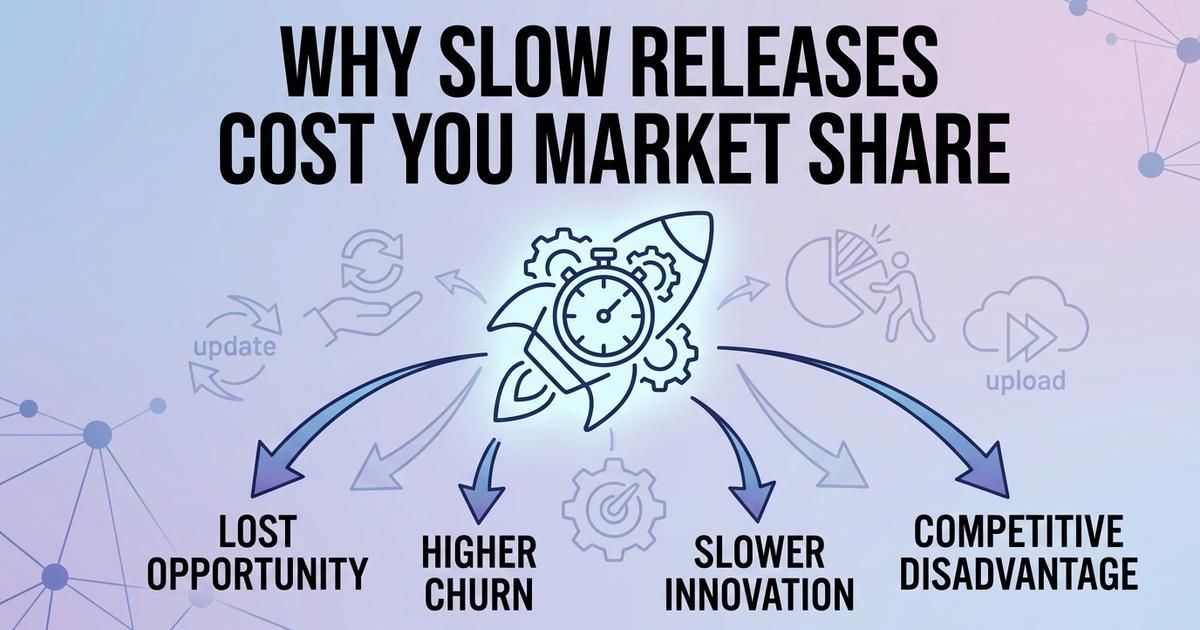

Why Slow Releases Are Costing You Market Share
Two companies can build equally good products and end up in very different competitive positions, purely based on how fast one of them can ship. Release speed isn't a technical nicety — it's a compounding advantage that shows up directly in who wins the customer.
Want to know what's slowing down your release cycle?
When leadership asks "why does it take so long to ship anything," the answer engineering usually gives is technical: testing overhead, deployment complexity, legacy dependencies. Those answers are true, but they miss the business framing that actually matters. Slow releases aren't a technical inconvenience — they're a direct constraint on how fast your organization can respond to customers, competitors, and market shifts. And the data shows the gap between fast and slow organizations is large and growing.
Stats That Matter
- Organizations with mature DevOps practices report roughly a 200% increase in deployment frequency and a 50% reduction in time-to-market compared to less mature peers.
- 49% of companies report a direct reduction in time-to-market for software and services as a result of DevOps adoption.
- Earlier defect detection through continuous testing cuts quality-related costs by up to 60%, meaning faster releases and higher quality are not actually in tension when the underlying practices are mature.
Why Release Speed Is a Market Share Question, Not Just an Engineering One
Every feature sitting in a backlog waiting for a slow release cycle is a feature your competitor might ship first. In markets where customer switching costs are low and competitors are actively iterating, the company that closes the gap between "we have an idea" and "customers are using it" fastest tends to win disproportionate market share — not because their idea was better, but because they got there first and iterated while the competitor was still in a release queue.
This dynamic compounds. A slow-shipping competitor doesn't just lose one feature race — they lose the ability to respond to customer feedback quickly, which means their next release is informed by older, staler information than a fast-shipping competitor's next release. Over several cycles, the gap between the two organizations widens rather than staying constant.
Why This Isn't Simply "Hire More Engineers"
The instinctive response to slow releases is to add headcount, but the data doesn't support that as the primary lever. The organizations achieving dramatically faster release cycles aren't necessarily larger — they've invested in the practices and infrastructure that remove friction from the release process itself: automated testing, continuous integration and deployment pipelines, and clear ownership over what gets shipped and when.
This matters for how leadership should think about the investment. Speeding up release cycles is less about adding capacity and more about removing the accumulated friction — much of which traces directly back to technical debt and unclear engineering processes, both covered elsewhere in this series. Fixing the release pipeline is frequently cheaper than hiring more engineers to work around a broken one, and it compounds in value every single release cycle going forward.
The Quality Objection — And Why It Doesn't Hold Up
A common concern from leadership is that faster releases mean sacrificing quality — "we'd rather ship less often and get it right." This is a reasonable instinct, but the data consistently contradicts it. Organizations with the most mature release practices don't just ship faster — they also see fewer failures per release and faster recovery when something does go wrong. Speed and quality aren't actually in tension once an organization has invested in the underlying practices; they're correlated, because catching defects early through continuous testing is dramatically cheaper than catching them after a long release cycle has bundled many changes together into one high-risk deployment.
The organizations still treating "slow but careful" as their strategy are usually not actually achieving more careful outcomes — they're bundling more risk into each release because changes accumulate while waiting for the next release window, which makes each individual release riskier, not safer.
What Leadership Should Actually Look At
Rather than asking "why can't we ship faster," which tends to produce defensive answers from engineering, a more productive leadership question is: what is standing between a completed piece of work and it being in front of customers? That question surfaces the real bottlenecks, which are usually one or more of:
Manual, infrequent deployment processes. If shipping requires a person to manually coordinate a release, that step alone caps how often releases can safely happen, regardless of how fast development itself is.
Batched, high-risk releases. Releasing rarely means each release bundles more changes, which makes each one riskier and slower to validate — a self-reinforcing cycle that gets worse the less often an organization ships.
Unclear release ownership. When no one has clear authority to decide a release is ready, delays accumulate through unnecessary escalation and second-guessing rather than genuine risk assessment.
What to Actually Fund
This isn't a call for a large infrastructure overhaul budget without a plan. It's a call to treat release velocity as a metric leadership tracks the same way it tracks sales cycle length or customer acquisition cost — because it has a comparably direct effect on competitive position.
Ask for deployment frequency as a standing metric, not just delivery dates for specific features. A team that ships small changes frequently is structurally healthier than one that ships large changes rarely, even if both eventually deliver the same features.
Fund the pipeline, not just the headcount. Investment in automated testing and deployment infrastructure typically pays for itself within a few release cycles by removing a bottleneck that persists indefinitely otherwise.
Treat release cadence as a competitive metric in strategy discussions, not purely an engineering operations detail — because it directly determines how fast your organization can respond to what the market is telling you.
Key Takeaways
- Organizations with mature release practices deploy roughly three times as often and cut time-to-market by half compared to less mature peers.
- Slow release cycles compound competitively — the gap between fast and slow organizations widens over successive cycles, not just once.
- Speed and quality are not actually in tension once the underlying practices are mature; faster, smaller releases tend to have fewer failures than infrequent, bundled ones.
- The primary fix is usually removing friction in the release pipeline — automated testing, deployment infrastructure, and clear release ownership — rather than simply adding headcount.
- Leadership should track deployment frequency as a standing competitive metric, not just as an internal engineering detail.
What to Do Next
If your organization's release cycle feels slower than it should, that's usually a fixable process and practice gap — not a sign you need to double your engineering headcount.
I work with a trainer who specializes in exactly this: helping engineering and leadership teams build the practices that turn release speed into a competitive advantage. If this is on your radar for the next quarter, call or contact me and I'll help you get started.