
Build vs. Buy: Investing in AI Capability
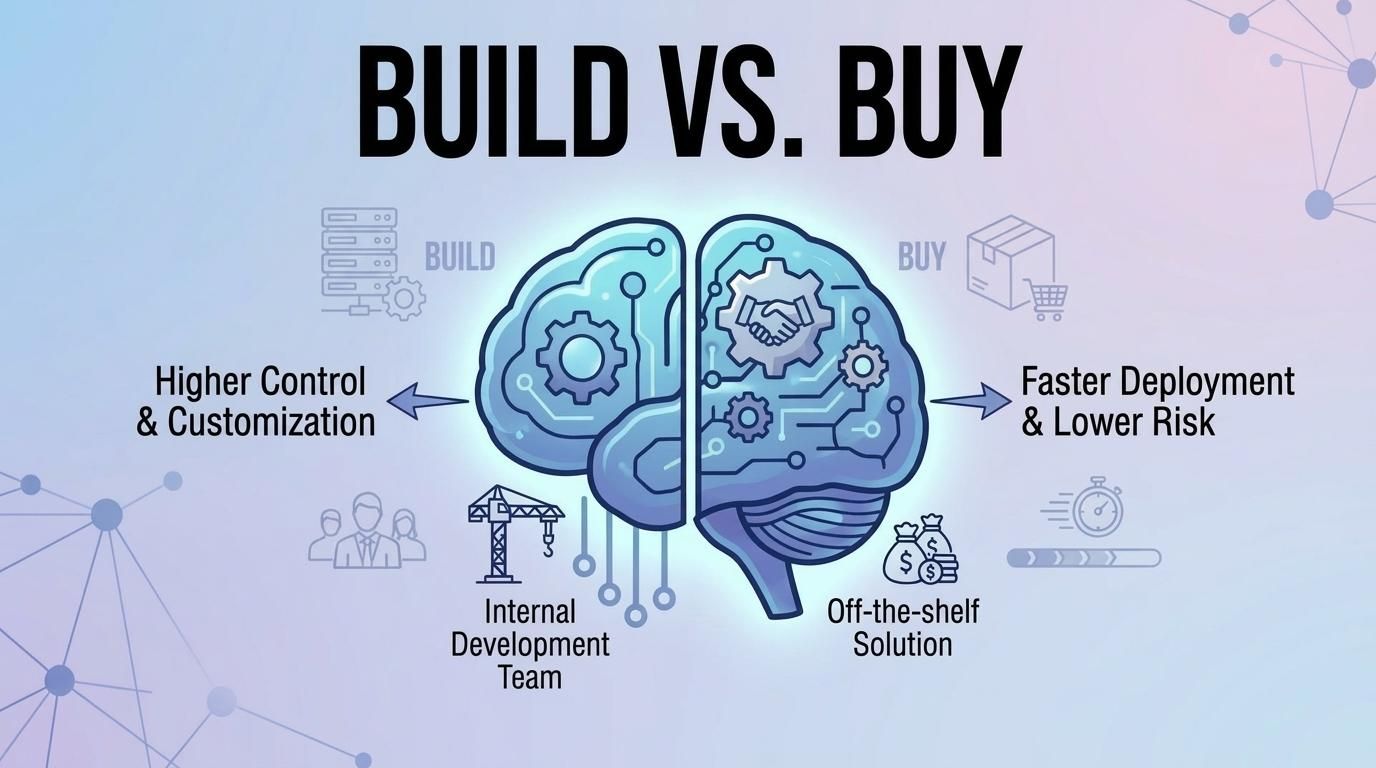

Build vs. Buy: What Leadership Should Know Before Investing in AI Capability
"The question is no longer whether AI will transform your enterprise. The question is whether you'll own the transformation or rent it." That framing sounds decisive, but the data says most companies shouldn't answer it once — they should answer it differently for every use case, and getting it wrong in either direction is an expensive mistake.
Not sure whether to build or buy your next AI capability?
Every AI initiative eventually arrives at the same fork: build the capability internally, or buy it from a vendor. Leadership teams often treat this as a single, company-wide philosophy — "we're a build company" or "we're a buy company" — when the data suggests that mindset is precisely what leads to expensive mistakes.
"The question is no longer whether AI will transform your enterprise. The question is whether you'll own the transformation or rent it." — Erik Brynjolfsson, Director, Stanford Digital Economy Lab
The Data Favors Buying First — But Not Buying Forever
For most organizations, especially those without deep in-house AI expertise, the numbers clearly favor starting with a buy-first posture. Vendor-led AI implementations succeed roughly twice as often as pure internal builds, and companies that pilot a buy-first approach before committing to custom development report meaningfully higher ROI than those that build first. Roughly three-quarters of enterprise AI use cases today end up purchased rather than built internally — a dramatic shift from a roughly even split just two years ago.
The reasoning behind this isn't complicated: custom AI development without institutional expertise carries a very high failure rate for first-time enterprise builders, and enterprises that skip validating a use case with a vendor first frequently waste over a year on a custom build that a proof-of-concept could have de-risked in weeks.
Stats That Matter
- Vendor-led AI implementations achieve roughly 67% success rates, compared to about 33% for pure internal builds.
- Companies that pilot a buy-first approach before committing to custom AI development report 3.2x higher ROI, according to Forrester's 2026 research.
- Roughly 76% of enterprise AI use cases are now purchased rather than built internally — up from a near-even split two years ago.
Why "Buy Everything" Is Also the Wrong Answer
This doesn't mean building is never the right call — it means building should be reserved for the specific cases where it earns its cost. The clearest signal that building is justified is when the use case sits close to what actually differentiates your business competitively, or when regulatory requirements demand that inference happen on infrastructure your organization fully controls — common in healthcare, defense, and financial services.
There's also a strategic risk on the "buy everything" side that leadership should weigh carefully: renting core capability from a vendor means accepting real dependency. Vendors have repriced contracts mid-term, restricted access under regulatory pressure, and turned finished workflows into building blocks you now have to build on top of rather than complete solutions you control. None of this makes buying wrong — it makes it a decision with real trade-offs that deserve the same scrutiny leadership applies to any other vendor dependency.
The Framework That Actually Works: Hybrid by Default
The organizations getting this right in 2026 have mostly stopped treating build vs. buy as a binary. The dominant pattern is a hybrid architecture: buy the foundation — the underlying models and infrastructure — and build the differentiating layer on top of it, whether that's proprietary data integration, task-specific agents, or workflow logic that no vendor platform can offer out of the box.
A useful way to frame this for a leadership discussion is a three-question filter for any proposed AI initiative:
Capability — do we have the internal AI talent to execute a build well? If not, buying or partnering with a specialized firm is almost always the lower-risk path, at least initially.
Complexity — is this a standard use case, or does it require deep customization tied to proprietary data or workflows? Standard use cases are well served by mature vendor platforms; proprietary, complex use cases are where building starts to earn its cost.
Criticality — how central is this initiative to our actual competitive advantage? Low criticality, standard complexity use cases should almost always be bought. High criticality, high complexity, low internal capability is the combination that most often justifies bringing in a specialized development partner to co-build, rather than either extreme of pure buy or pure internal build.
The Cost Comparison Leadership Should Actually Model
A common mistake is comparing sticker prices rather than total cost of ownership. Custom enterprise AI platforms can run from the low hundreds of thousands into the low millions upfront, with significant ongoing maintenance, while purchased platforms often start far lower with predictable usage-based pricing. But that comparison flatters buying if it ignores the long-run costs of customization, integration work, and vendor lock-in that frequently emerge well after the initial contract is signed. The honest comparison is a 36-month total cost model, not a first-year invoice.
What Leadership Should Ask Before Approving Either Path
For a "buy" proposal: What happens to this capability if the vendor changes pricing, gets acquired, or discontinues the product? Is there a realistic exit path, or does this create a dependency we can't unwind?
For a "build" proposal: Have we validated this use case with a vendor proof-of-concept first? Do we have the internal capability to build and, just as importantly, maintain this over the long run — or are we underestimating the ongoing cost of ownership?
For either path: Is this use case central enough to our competitive advantage to justify the higher-risk, higher-control option, or would a vendor solution free up our best people to focus on what actually differentiates us?
Key Takeaways
- Vendor-led AI implementations succeed roughly twice as often as pure internal builds — a buy-first posture significantly reduces early-stage risk.
- Building is best reserved for use cases close to your core competitive advantage, or where regulatory requirements demand full infrastructure control.
- The dominant winning pattern in 2026 is hybrid: buy the foundation, build the differentiating layer on top.
- Compare total cost of ownership over a multi-year horizon, not first-year sticker price — buying can become more expensive than building once customization and lock-in costs are included.
- Use a three-factor filter — capability, complexity, criticality — to decide which path fits a specific initiative, rather than adopting a single company-wide philosophy.
What to Do Next
If your leadership team doesn't yet have a clear, repeatable framework for deciding build vs. buy on AI initiatives, that decision quality is trainable — and it's cheaper to build the judgment now than to unwind a bad build or an over-committed vendor contract later.
I work with a trainer who specializes in exactly this: helping leadership teams build the decision frameworks and internal capability needed to make confident build-vs-buy calls on AI investment. If this is on your radar for the next quarter, call or contact me and I'll help you get started.