
Technical Debt: The Silent Roadmap Tax
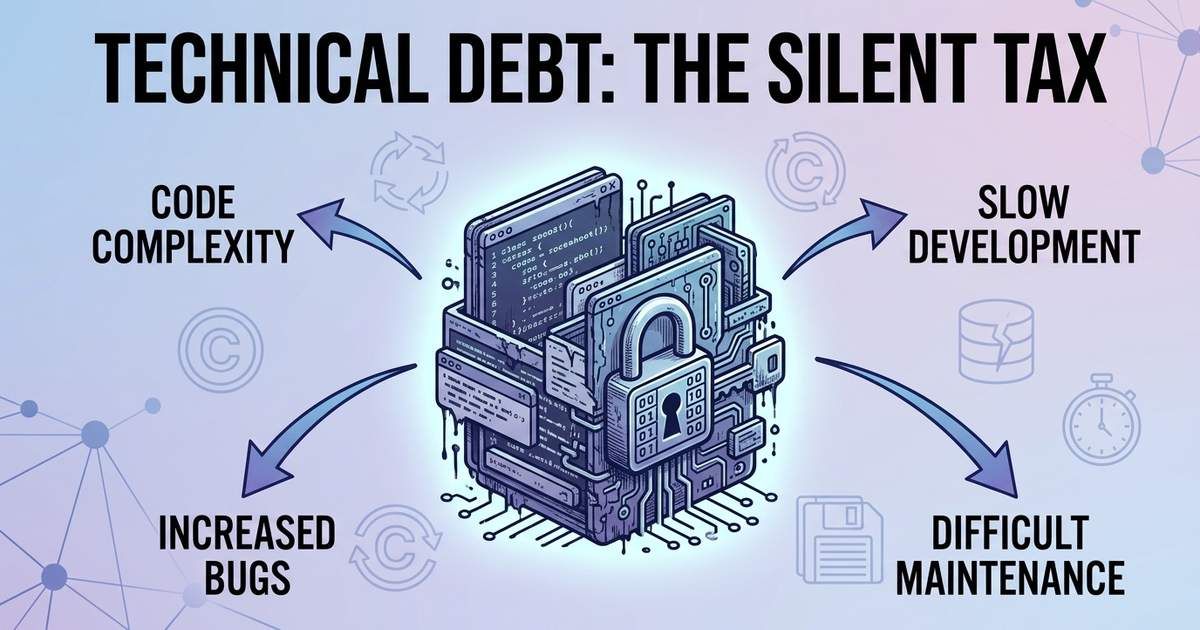

Technical Debt: The Silent Tax on Your Product Roadmap
Somewhere between a fifth and nearly half of your entire IT budget may currently be going toward servicing debt you never approved and can't see on any invoice. It doesn't show up as a cost overrun — it shows up as a roadmap that keeps slipping for reasons nobody can quite explain.
Want visibility into what technical debt is really costing your roadmap?
Every finance leader understands interest payments. Borrow now, pay more later, and if the debt grows faster than your ability to service it, the interest eventually crowds out everything else you wanted to spend on. Technical debt works exactly the same way, except the "interest" gets paid in engineering time instead of dollars — which is precisely why it's so easy for leadership to miss until it's already expensive.
Stats That Matter
- Technical debt absorbs an estimated 21% to 40% of total IT spending, according to Deloitte's 2026 Global Technology Leadership Study.
- Engineers in high-debt codebases lose 20% to 50% of their productive time to workarounds, rework, and navigating complexity rather than building new features.
- Organizations that actively manage technical debt free up engineers to spend up to 50% more time on work that supports business goals, per McKinsey research.
Why This Is a Financial Concept, Not a Technical One
The word "debt" is doing real work in this term, and it's worth taking literally. Every shortcut taken to hit a deadline — skipping tests, hardcoding a value that should be configurable, patching around a design flaw instead of fixing it — accrues interest. That interest gets paid every time someone has to work around, rather than with, that decision. Unlike financial debt, there's no monthly statement telling leadership the balance is growing. It shows up instead as slower delivery, more incidents, and a roadmap that consistently underperforms its estimates.
Why It Stays Invisible Until It's Expensive
Technical debt doesn't announce itself. It doesn't block a demo, and short-term feature delivery can look perfectly healthy right up until velocity collapses under its own weight. Leadership typically sees the downstream symptoms — a project that's mysteriously behind schedule, a bug that keeps recurring, an engineer who quietly leaves — without connecting them to a common root cause, because debt lives inside the codebase, not on a dashboard leadership normally reviews.
By the time it becomes visible in a way executives register, it's often been compounding for a year or more, and every additional percentage point of debt costs more to work around than the last one, because the codebase's complexity is no longer linear — it's compounding.
The Cost Breaks Down Into Four Layers
Lost productivity. This is the most direct and measurable cost. Engineers routinely lose a fifth to half of their time to workarounds and rework rather than building anything new — meaning a meaningful share of your engineering payroll is effectively funding maintenance rather than growth.
Slower, riskier delivery. Teams carrying heavy technical debt report several times more production incidents than teams working in clean codebases, and fixing a bug after the fact typically costs several times more than catching the same issue at design time. Feature delivery in high-debt environments can run two to four times slower than in equivalent low-debt teams.
Onboarding and retention drag. New engineers take two to three times longer to onboard into a high-debt codebase, and experienced engineers — the ones you can least afford to lose — tend to leave specifically because too much of their time goes to patching avoidable problems rather than solving meaningful ones.
Blocked strategic initiatives. This is the layer most relevant to current AI ambitions: a large share of enterprises report that technical debt is actively blocking their ability to scale AI initiatives, and unresolved technical debt has been shown to measurably reduce the return on AI investment when the two aren't addressed together.
The "Silent Tax" Compounds With Every New Initiative
This is where the framing in this article's title matters most for a C-suite reader. Technical debt isn't a one-time cost — it's closer to a tax rate applied to every future initiative your organization tries to build. A new feature that should take a week can take three because the team first has to untangle brittle, undocumented logic just to make room for the new work. A new AI initiative meant to be a competitive advantage can underperform specifically because the underlying systems weren't built to support it. The tax doesn't apply once; it applies to every dollar of new investment layered on top of the existing debt.
Not All Debt Is Bad — But Unmanaged Debt Always Is
It's worth being precise here: technical debt is not inherently a mistake. A company shipping quickly to prove product-market fit should reasonably take on some debt deliberately — that's a legitimate strategic tool, the same way a business might take on financial debt to fund growth it couldn't otherwise afford. The distinction that matters is between debt taken on knowingly, tracked, and repaid on a plan versus debt that accumulates silently because nobody owns tracking it or repaying it. The first is a lever. The second is a liability leadership doesn't know it's carrying.
What Leadership Actually Needs to Approve
This is not a call to hand engineering a blank check to "go fix the codebase." It's a resourcing and prioritization decision that requires explicit leadership sign-off, because it competes directly with feature delivery for the same engineering capacity.
Protected capacity for debt reduction. A commonly cited range is 15-20% of each sprint dedicated to debt work, treated as non-negotiable rather than something that only happens "when there's time" — which in practice means never.
A debt inventory, not a vague concern. Ask engineering leadership to translate technical debt into terms that connect to funding decisions: which initiatives are currently blocked or slowed by it, and what specific incidents or delays trace back to it.
A decision framework for how much debt is acceptable. Debt taken on deliberately to hit a market window, with an explicit plan to repay it, is a strategic choice. Debt that has never been tracked or discussed at the leadership level is a risk that's compounding without anyone's approval.
Key Takeaways
- Technical debt can absorb 21% to 40% of total IT spending — a hidden tax most leadership teams have never seen quantified.
- It stays invisible in standard reporting because it doesn't cause a single dramatic failure — it accumulates as slower delivery, more incidents, and quiet attrition.
- Debt compounds against every future initiative built on top of it, including current AI investments, which are frequently blocked or underperform because of unresolved technical debt.
- Not all debt is bad — debt taken on deliberately and repaid on a plan is a legitimate strategic tool; debt nobody tracks or owns is simply a growing liability.
- Leadership should approve protected engineering capacity for debt reduction and request a debt inventory tied to specific business impact, not just a general engineering concern.
What to Do Next
If your organization doesn't have a clear picture of how much technical debt is slowing your roadmap, or your teams don't have a shared framework for deciding how much debt is acceptable, that's a trainable gap.
I work with a trainer who specializes in exactly this: helping engineering and leadership teams build the practices to measure, price, and manage technical debt before it silently taxes your next big initiative. If this is on your radar for the next quarter, call or contact me and I'll help you get started.