
Why AI is a Business Initiative, Not Tech
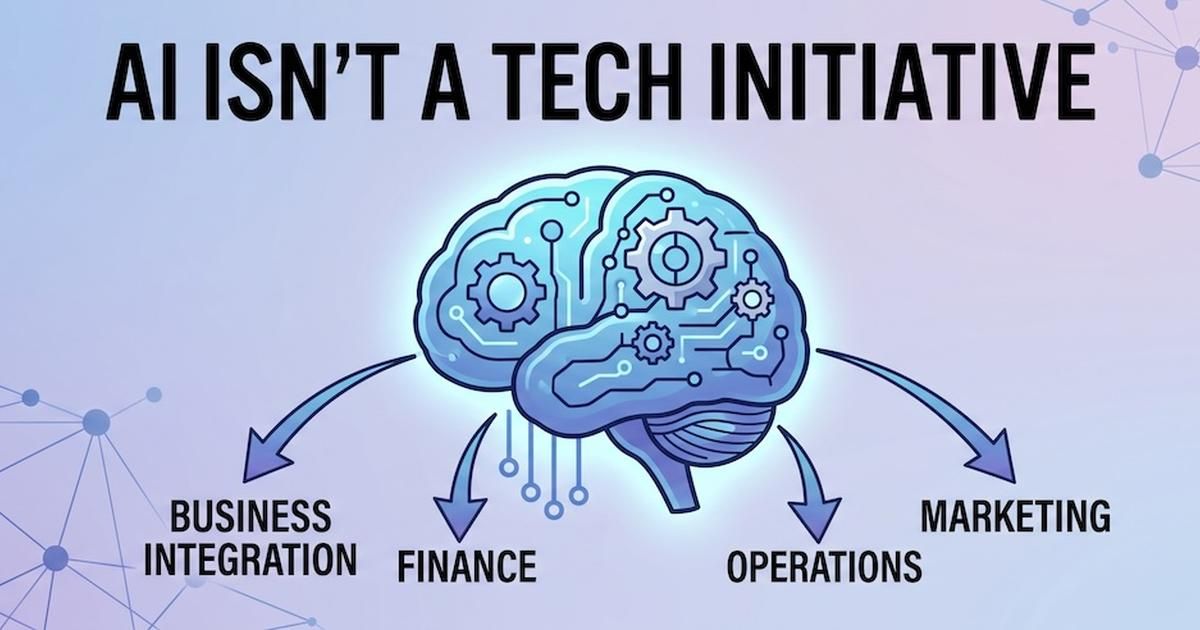

AI Isn't a Tech Initiative — It's a Business Strategy Your Competitors Already Have
While you're waiting for the "right moment" to invest in AI, at least one competitor has already stopped debating and started compounding an advantage you won't see on a dashboard until it's too late to close. This isn't a tooling decision — it's a strategy decision, and the cost of delay is invisible until it isn't.
Ready to close this gap in your own organization?
There's a comfortable myth many leadership teams tell themselves: "We'll get to AI once we have the right team, the right budget, and the right moment." It sounds prudent. It sounds like discipline. In reality, it's a strategic blind spot — because while your organization waits for the "right moment," your competitors have already reframed AI from an IT line item into a boardroom priority.
The mistake isn't hesitation. It's the categorization. As long as AI sits in the "technology" bucket, it gets evaluated with technology logic: cost, complexity, risk of failure, wait-and-see. But AI adoption isn't behaving like a typical IT rollout — it's behaving like a market shift, the kind that separates companies who compounded an advantage early from companies who spent two years catching up.
"Speed is one of your main advantages over large competitors." — Sam Altman, CEO, OpenAI
That's not a warning about some distant future — it's already playing out inside individual industries today. The organizations moving fastest right now aren't waiting for certainty; they're building it through action.
Stats That Matter
- 72% of enterprises now have at least one AI workload in production, up from just 20% in 2020 — the adoption curve is steep and accelerating.
- Organizations that redesign work processes around AI are twice as likely to exceed their revenue goals, according to Gartner's 2025 survey of nearly 2,000 managers.
- 94% of executives say they'll keep investing in AI even without proven returns yet — a signal that leadership sees this as a structural bet, not a discretionary spend.
Why This Is a Strategy Conversation, Not a Tech Conversation
Every major shift in business capability — the internet, mobile, cloud — followed the same pattern. Early on, it looked optional. Leadership treated it as something to delegate to a department. Then a threshold was crossed, and the companies that had been quietly building capability pulled decisively ahead — not because their technology was better, but because their organization had already learned how to absorb and operationalize the change.
AI is following that exact curve, except faster. The tools compound quickly: a team using AI-assisted development ships features weeks earlier; a support function using AI triage handles volume without adding headcount; a sales team using AI-generated insights walks into negotiations better prepared. None of these are single wins. They are structural speed advantages that accumulate month over month.
The companies pulling ahead right now aren't necessarily the ones with the most sophisticated AI. They're the ones where leadership stopped asking "should we do this?" eighteen months ago and started asking "how fast can we responsibly scale this?"
The Real Question Isn't "What Can AI Do?" — It's "What Is Inaction Costing Us?"
Most executive conversations about AI start with capability: What can it do? What are the use cases? This is the wrong starting point, because it treats AI like a feature to be evaluated rather than a shift in the competitive baseline.
The more useful question is quieter and harder to answer: What does it cost us, every quarter, to not have this capability while others do? That cost shows up in places that don't have a line item — slower time-to-market on features, higher cost-per-transaction in operations, junior talent choosing employers who already offer modern tooling, and sales cycles lost to competitors who can move faster and personalize better.
None of these costs appear on a dashboard labeled "AI ROI." They appear as slowly eroding margins and market share that leadership often attributes to other causes — market conditions, hiring challenges, execution issues — without recognizing the common thread.
Why "Wait and See" Is Itself a Decision
There's an assumption embedded in delay: that the option to catch up later remains open and roughly equally costly whenever you choose to act. That assumption doesn't hold for capability-driven shifts. The organizations that start now aren't just adopting tools — they're building institutional muscle: engineers who know how to integrate AI responsibly, data practices clean enough to be usable, workflows redesigned around new capability, and a culture that treats experimentation as normal rather than risky.
That muscle takes time to build regardless of budget. A company with unlimited capital but zero organizational experience is still behind a company with a modest budget and eighteen months of hands-on learning. Waiting doesn't preserve optionality — it defers the hardest, slowest part of the work to a later date when competitors will have already solved it.
What This Means for the C-Suite Specifically
This is not a call to hand engineering a blank check for "AI stuff." It's a call to treat AI capability the way you'd treat any other strategic asset — market position, brand, distribution network — that compounds when invested in early and is expensive to rebuild once lost.
Practically, that means three shifts in how leadership engages with this topic:
Move it out of the IT budget conversation and into the strategy conversation. If AI only comes up when the CTO requests tooling budget, it will always be evaluated as a cost rather than a capability. It belongs in the same conversation as market expansion or new product lines.
Ask for a capability roadmap, not a use-case list. Use cases are tactical and will always look small in isolation. A capability roadmap answers a bigger question: in eighteen months, what can our organization do that it cannot do today, and what does that unlock competitively?
Fund the learning curve, not just the tools. The tools are increasingly commoditized and cheap. The scarce resource is organizational experience — teams who have made mistakes, learned what doesn't work, and built judgment about where AI genuinely helps versus where it adds risk. That experience only comes from starting.
The Competitive Window Is Narrower Than It Looks
It's tempting to believe there's still ample time, because AI adoption still feels early-stage in public discourse. But inside individual industries, the gap is already visible to those close to the ground: procurement teams noticing competitors respond to RFPs faster, sales teams losing deals to better-personalized pitches, engineering leaders watching peer companies ship at a pace that used to require double the headcount.
By the time a competitive gap is visible in quarterly numbers, it has usually existed operationally for a year or more. Leadership teams that wait for undeniable proof before acting are, by definition, choosing to act after the advantage has already been captured by someone else.

Key Takeaways
- AI adoption behaves like a strategic capability shift, not a routine technology upgrade — early movers compound advantages that are difficult to reverse later.
- The real cost of delay is invisible in standard reporting; it shows up as slower delivery, margin erosion, and talent attrition long before it shows up as an "AI problem."
- Waiting does not preserve optionality — the organizational learning curve takes time regardless of budget, and that time is the actual scarce resource.
- Leadership should evaluate AI as a strategic asset in the same conversation as market expansion, not as a line item inside the IT budget.
- The competitive gap is often invisible in official numbers well before it becomes undeniable — by then, it's already a year or more in the making.
What to Do Next
If your organization is still treating AI as something to "get to eventually," the most valuable next step isn't a bigger budget — it's building the internal judgment your teams need to adopt AI responsibly and effectively. That's a training and capability-building problem, not just a tooling problem.
I work with a trainer who specializes in exactly this: helping leadership teams and their people build real, working AI capability rather than surface-level familiarity. If closing this gap is on your radar for the next quarter, call or contact me and I'll help you get started.