AI Production Failures and Governance
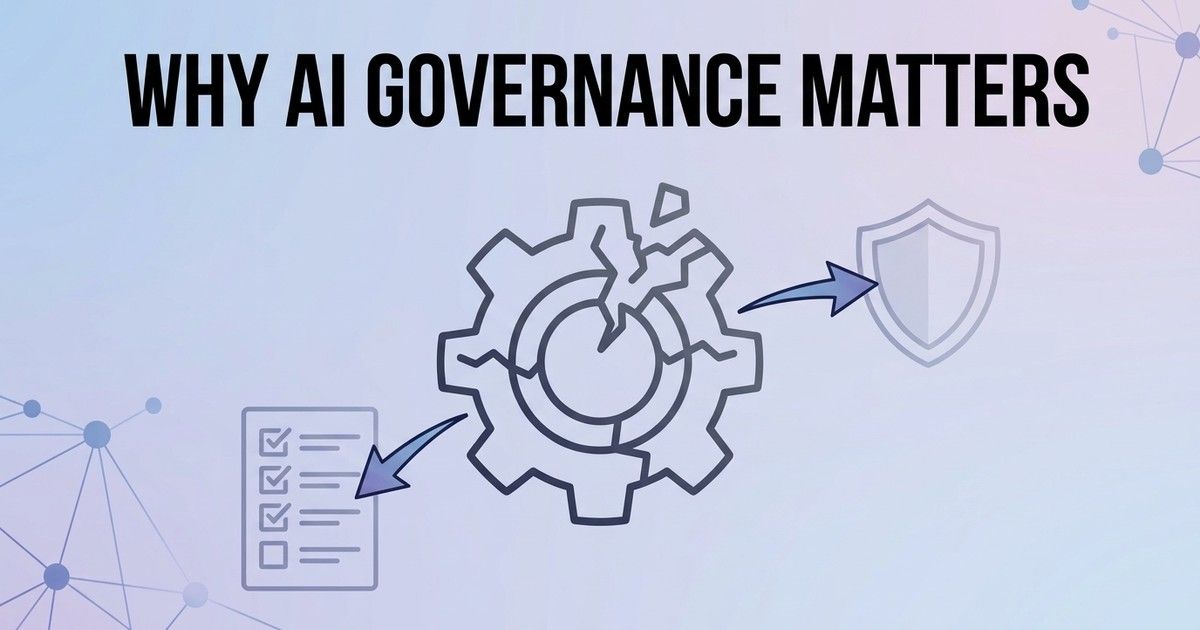

What Happens When AI Fails in Production — And Why Governance Matters
Eighty-eight percent of organizations are actively using AI across business functions. Only 8% have a comprehensive governance framework to go with it. That gap between adoption and governance isn't a rounding error — it's the exact space where expensive, avoidable AI failures live.
Want to know if your AI governance gap is exposing you to unnecessary risk?
Most conversations about AI risk focus on the technology itself failing — a model hallucinating, an agent taking a wrong action. That's a real risk, but it's not the dominant one. The evidence consistently points somewhere else: AI failure in the enterprise is overwhelmingly organizational, not technical. Projects don't usually fail because the model wasn't good enough. They fail because nobody had built the governance, ownership, and operational discipline to deploy it safely and keep it that way.
Stats That Matter
- More than 80% of enterprise AI projects fail — roughly twice the failure rate of conventional IT projects, according to RAND Corporation research.
- Only 8% of organizations globally have a comprehensive AI governance framework, even though 88% are actively using AI across business functions.
- AI-related incidents rose 55% year-over-year, from 233 in 2024 to 362 in 2025 — and only 21% of organizations planning to adopt autonomous AI agents have a mature governance model in place for them.
Why "The Model Failed" Is Rarely the Real Story
When an AI initiative fails or causes a visible incident, the instinct is to look at the technology first. The evidence says to look elsewhere. Root-cause analysis of failed AI projects consistently points to the same drivers: unclear definitions of success, weak data foundations, poor integration into real workflows, chasing the technology rather than the business outcome, and executive sponsorship that faded once the initial excitement wore off. None of these are model problems. They're organizational discipline problems that show up wearing an AI costume.
This matters enormously for how leadership should respond when something goes wrong. If an AI failure gets treated as a technology problem — "we need a better model" or "we need a different vendor" — the underlying governance gap that actually caused it goes unaddressed, and the same failure mode recurs on the next initiative.
The Governance Gap Is Widening, Not Closing
The concerning part isn't just that governance is currently thin — it's that AI capability is spreading through organizations faster than governance and visibility can keep pace. Over half of organizations lack a systematic inventory of the AI systems currently running in their own production or development environments. You cannot govern, secure, or hold accountable something your organization doesn't even know exists — and a majority of technology leaders express real uncertainty about whether AI-generated internal tools have already caused a production incident they simply haven't detected.
Agentic AI — systems that act autonomously across multi-step workflows rather than simply responding to a single prompt — makes this gap more acute, not less. A large majority of organizations plan to adopt agentic AI within the next two years, but only about one in five currently has a mature governance model built for the specific risks autonomous action introduces. Gartner has gone as far as predicting that a meaningful share of enterprises will be forced to demote or decommission autonomous AI agents specifically because governance gaps only became visible after a production incident — governance built reactively, under pressure, after the damage is already done.
Why Uniform, One-Size-Fits-All Governance Also Fails
It's tempting for leadership to respond to this gap by locking everything down uniformly — treating all AI initiatives with the same maximum caution. This instinct, while understandable, is itself identified as a root cause of governance failure. Enterprises that treat AI governance as binary — either fully locked down or fully trusted — tend to fail regardless of which extreme they choose, because a uniform policy is either too restrictive to let legitimate, low-risk use cases move at a reasonable pace, or too permissive to catch the genuinely high-risk ones before they cause damage.
Effective governance instead calibrates oversight to actual risk: a customer-facing autonomous agent making financial decisions needs materially more scrutiny than an internal tool summarizing meeting notes, and treating both identically wastes governance capacity on the low-risk case while under-protecting the high-risk one.
What Good Governance Actually Looks Like
The organizations avoiding the worst of these failure patterns share a specific, repeatable set of practices, not a vague commitment to "being careful with AI."
A visible executive sponsor with real authority. Governance functions created without an empowered sponsor — someone with actual decision rights and veto authority, not just a title — tend to get bypassed under delivery pressure, and incidents end up escalating straight to the boardroom instead of being caught early.
A living inventory of what's actually in production. You cannot govern what you cannot see. A central inventory tracking what AI systems exist, who owns them, and what they're authorized to do is the foundational layer everything else depends on.
Risk-calibrated oversight, not uniform lockdown. Governance intensity should scale with what an AI system is authorized to do and what data it can access — not apply the same rulebook to every use case regardless of its actual risk profile.
Regular, concrete reporting to leadership. Monthly, brief executive updates and quarterly company-wide briefings — covering wins, mitigated risks, and quantified business value — keep governance visible as an enabler rather than a silo that leadership only hears from when something has already gone wrong.
What Leadership Should Ask Right Now
Do we actually know what AI systems are running in our organization today? If the honest answer is uncertain, that uncertainty is itself the highest-priority governance gap to close.
Who has real authority — not just responsibility — for AI governance decisions? Responsibility without decision-making authority produces the exact pattern of being bypassed under pressure that shows up repeatedly in failed governance functions.
Is our oversight calibrated to risk, or applied uniformly regardless of what a system is authorized to do? Uniform governance is a documented failure pattern in its own right, not a safe default.
Key Takeaways
- More than 80% of enterprise AI projects fail, and the dominant causes are organizational — unclear goals, weak data foundations, and fading sponsorship — not model quality.
- Only 8% of organizations have a comprehensive AI governance framework despite 88% actively using AI, and AI-related incidents rose 55% year-over-year.
- Agentic AI is outpacing governance maturity fastest — most organizations plan to adopt it within two years, but very few have a governance model built for autonomous action.
- Uniform, one-size-fits-all governance is itself a documented failure pattern; effective governance calibrates oversight to the actual risk of each system.
- Leadership should prioritize a real inventory of existing AI systems and an empowered governance sponsor with genuine decision-making authority, not just a title.
What to Do Next
If your organization doesn't have a clear, current inventory of the AI systems already running, or governance decisions don't have a genuinely empowered owner, that gap is one of the highest-leverage things to close before your next AI initiative scales.
I work with a trainer who specializes in exactly this: helping leadership and technical teams build the governance discipline that lets AI initiatives scale safely instead of becoming the next production incident. If this is on your radar for the next quarter, call or contact me and I'll help you get started.